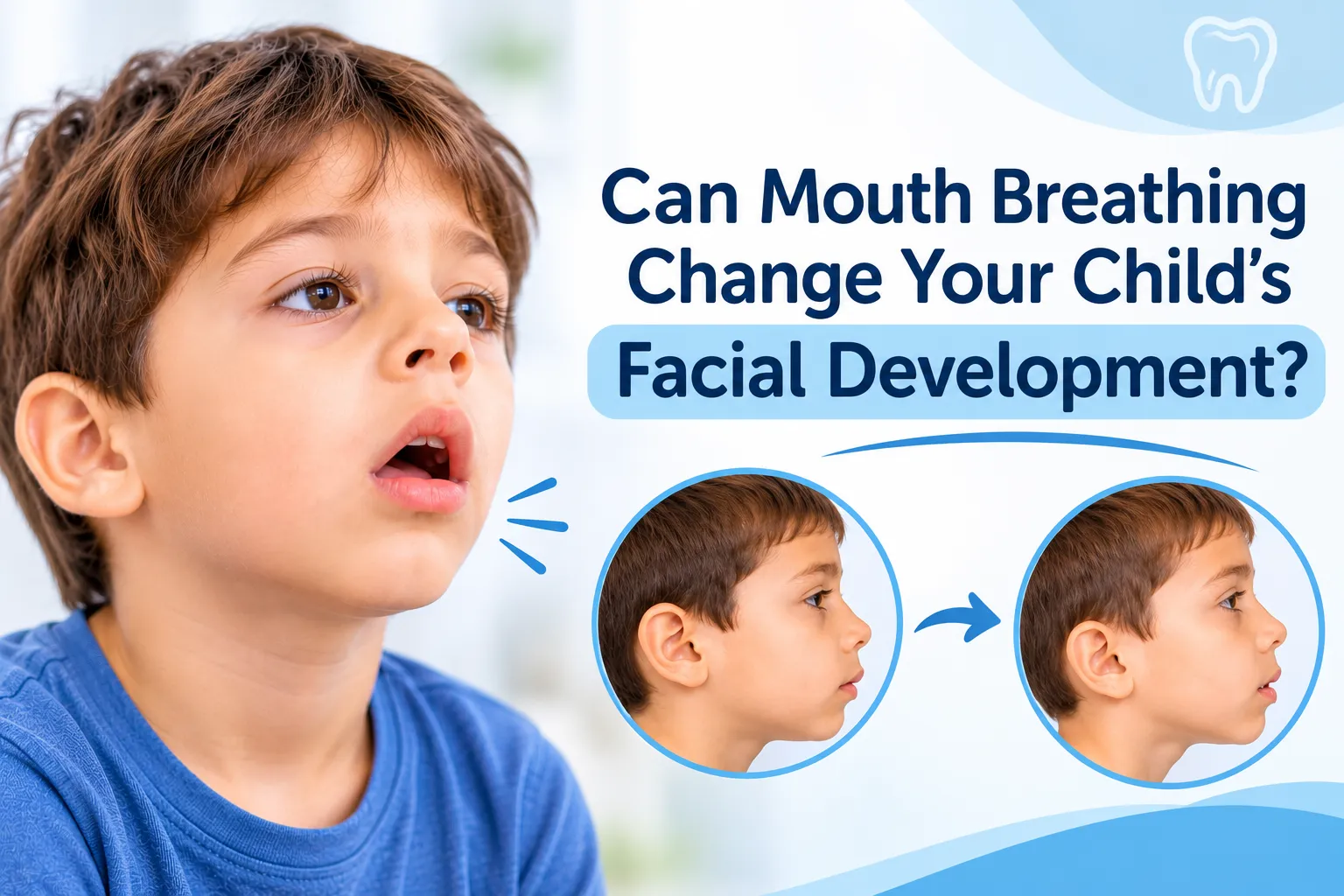

A child’s facial development is influenced by genetics, nutrition, oral habits, breathing patterns, and overall growth. While parents often pay attention to their child’s teeth, one important habit that can go unnoticed is mouth breathing. If your child frequently sleeps with their mouth open, breathes through their mouth during the day, regularly snores, or has heavy noisy breathing it may be worth investigating the underlying cause.
Can mouth breathing actually change your child’s facial structure? Research suggests that prolonged mouth breathing is associated with certain changes in jaw development, dental alignment, and facial growth. Understanding these signs early can help parents seek appropriate guidance from a pediatric dentist in Pune.
What Causes Mouth Breathing in Children?
Children naturally breathe through their noses. However, certain conditions can make nasal breathing difficult, causing them to breathe through their mouths.
Common causes include:
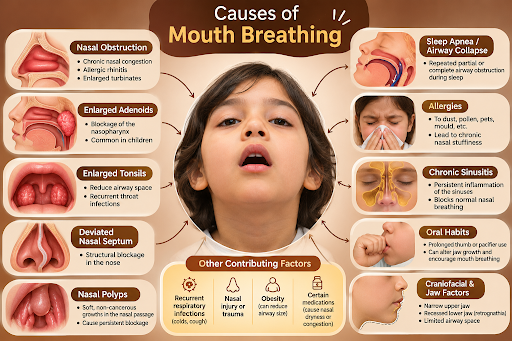
- Enlarged adenoids and tonsils: These tissues can partially block the airway.
- Allergic rhinitis: Allergies may cause nasal congestion and breathing difficulties.
- Chronic nasal blockage: Repeated infections or structural nasal problems can affect airflow.
- Deviated nasal septum: In some children, structural differences may restrict nasal breathing.
- Habitual mouth breathing: Some children continue breathing through their mouths even after the original blockage improves.
Identifying the actual cause is important because mouth breathing is often a symptom rather than an isolated problem.
How Can Mouth Breathing Affect Your Child’s Facial Development?
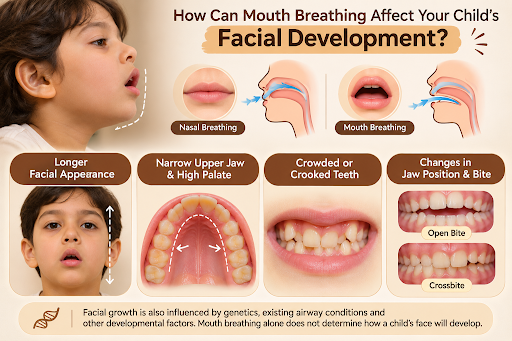
During childhood, the facial bones, jaws, and dental arches are still developing. Persistent mouth breathing may influence the balance of facial muscles and the position of the tongue, potentially affecting normal growth patterns.
1. Longer Facial Appearance
Children who consistently breathe through their mouths may develop an increased lower facial height. This can sometimes create a longer or narrower facial appearance, commonly described as an adenoid facial pattern.
2. Narrow Upper Jaw and High Palate
The tongue normally rests against the roof of the mouth when the lips are closed. With habitual mouth breathing, the tongue may rest in a lower position. This altered muscle balance is associated with a narrower upper jaw and a higher palatal arch in some children.
3. Crooked or Crowded Teeth
A narrow dental arch can reduce the available space for permanent teeth. As a result, children may experience crowded teeth, irregular alignment, or bite-related problems.
4. Changes in Jaw Position and Bite
Prolonged mouth breathing has been associated with certain bite problems, including an anterior open bite and posterior crossbite. Some children may also show changes in jaw growth patterns.
However, genetics, existing airway conditions, and other developmental factors also influence facial growth. Mouth breathing alone does not determine how a child’s face will develop.
Mouth Breathing, Narrowed Airways and Sleep-Disordered Breathing
Mouth breathing can also be a sign of an underlying airway obstruction, particularly when enlarged adenoids, tonsils or other nasal blockages restrict the normal flow of air. This may contribute to narrowing of the upper airway, especially during sleep, increasing the risk of sleep-disordered breathing and Obstructive Sleep Apnea (OSA). During sleep, repeated partial or complete airway obstruction can interrupt normal breathing, cause frequent micro-awakenings and reduce sleep quality. Although a child may appear to sleep for adequate hours, the sleep may not be restorative. As a result, children may experience daytime sleepiness, fatigue, reduced energy, difficulty concentrating, poor attention span and learning difficulties. Interestingly, sleep deprivation in children does not always present as sleepiness; some children may instead display hyperactivity, irritability, restlessness, behavioural changes or decreased academic performance. Persistent sleep disturbances may also affect overall well-being, growth and quality of life. Therefore, habitual mouth breathing, snoring, restless sleep or difficulty waking up should not be dismissed as mere habits. They warrant an assessment of the child’s nasal airway, tonsils, adenoids and sleep quality, with referral to an ENT specialist or sleep physician when indicated.
Signs and Symptoms Parents Should Look Out For
Mouth breathing in children can present through several signs, both during the day and while sleeping. Parents may notice a persistent open-mouth posture, dry lips, noisy or heavy breathing, frequent snoring, teeth grinding (bruxism), and excessive saliva drooling, particularly during sleep. Other signs may include restless sleep, frequent awakenings, nightmares, bedwetting (nocturnal enuresis), and difficulty waking up in the morning. Some children may also experience morning headaches, dark circles under the eyes, daytime sleepiness, fatigue, low energy and difficulty concentrating. Interestingly, poor-quality sleep can sometimes manifest as hyperactivity, impulsiveness, irritability and ADHD-like behavioural symptoms rather than obvious sleepiness. These symptoms may be associated with sleep-disordered breathing, including obstructive sleep apnea, particularly when enlarged adenoids or tonsils contribute to airway obstruction. However, none of these signs alone confirms sleep apnea or ADHD, and dark circles, bedwetting and teeth grinding can have other causes too. Recognising these patterns early can help parents seek appropriate airway and sleep assessment before the problem affects a child’s daily functioning, learning and overall well-being.
Quick checklist for parents
During the day
- Persistent open-mouth posture
- Dry lips and mouth
- Dark circles under the eyes
- Daytime sleepiness and fatigue
- Poor concentration and inattention
- Hyperactivity and irritability
- Morning headaches
During sleep
- Snoring
- Noisy or heavy breathing
- Teeth grinding
- Excessive drooling
- Restless sleep and frequent awakenings
- Nightmares
- Bedwetting
- Difficulty waking up in the morning
Important message for parents: If your child snores regularly, has pauses in breathing, gasps during sleep or persistently breathes through their mouth, seek an assessment by an ENT specialist or sleep physician. Early recognition and appropriate treatment of airway obstruction can make a meaningful difference to a child’s sleep and well-being.
The infographic above also incorporates these signs and symptoms, making it suitable for your blog or as an accompanying educational visual.
If these symptoms occur regularly, consider arranging a professional evaluation.
Why Early Pediatric Dental Evaluation Matters
Early identification helps parents understand whether a child’s breathing pattern is affecting oral health and developing dental structures.
At Vanilla Smiles Dental Clinic, Pune, Dr. Abhishek Soni (BDS, MDS, FIAPD), Pediatric and Preventive Dentistry Specialist, focuses on children’s dental development and preventive oral healthcare.
A pediatric dental evaluation may include:
- Examining jaw development and dental alignment.
- Checking the shape and width of the dental arches.
- Assessing oral habits and tongue posture.
- Identifying possible bite-related concerns.
- Recommending an Airway – Focused ENT evaluation when airway obstruction is suspected.
- Considering orthodontic assessment when clinically appropriate.
Treatment depends on the underlying cause. Some children may require ENT management for enlarged adenoids or allergies, while others may benefit from appropriate dental or orthodontic evaluation.
Importantly, orthodontic appliances should not be considered an automatic treatment for mouth breathing. Every child needs an individual assessment.
Can Mouth Breathing Be Prevented or Managed?
Parents can encourage healthy breathing habits by addressing nasal congestion, seeking medical advice for persistent allergies, maintaining regular dental visits, and monitoring sleep-related symptoms.
Avoid forcing your child to keep their mouth closed or using mouth taping. These approaches can be unsafe when nasal airflow is restricted.
The goal is to identify and manage the underlying breathing problem rather than simply correcting the visible habit.
Give Your Child’s Growing Smile the Right Attention
Facial development is a gradual process, and persistent mouth breathing should not be ignored during childhood. Although it does not guarantee changes in facial appearance, it can be associated with differences in jaw growth, palate development, and tooth alignment.
If you notice frequent mouth breathing, snoring, or dental alignment concerns, consult a qualified pediatric dentist.
Vanilla Smiles Dental Clinic in Pune offers children’s dental care under the guidance of Dr. Abhishek Soni. An early evaluation can help parents understand their child’s dental development and determine whether further assessment is needed.
Vanilla Smiles Dental Clinic
Dr. Abhishek Soni
BDS, MDS, FIAPD – Pediatric & Preventive Dentist
Find clinic here: Get direction
Call Now: +917028029383 / +919860633281
Address: Soni Capital, 2nd Floor, Near Shreyas Hotel, 1237, Apte Road, Shivaji Nagar, Pune, Maharashtra 411004 India
Disclaimer: AI-generated content, reviewed and edited by a Dentist.